
On October 22, in a targeted effort to advance academic strategy ahead of the 15th Five-Year Plan (2026-2030), Deputy secretary of the university’s party committee and president Zhang Yingchun led a delegation to the Business School for an intensive review and a symposium. Presided by Dean Zhou Xiaojun, the symposium brought together School of Business leadership, department heads, faculty representatives, and key administrators to exchange insights on advancing the institution's high-quality growth.
President Zhang conducted an inspection tour of the Business School's training facilities, including the on-campus SF Express logistics practice base, Logistics Culture Exhibition Hall, and E-commerce Livestreaming Studio. She engaged with students in hands-on training sessions, inquiring about their practical workflows and learning outcomes while encouraging them to integrate theoretical knowledge with real-world applications. During her visit to the preparation center for the 2025 World Vocational College Skills Competition finals, she commended students for their previous silver medal achievement and urged them to aim for greater success in future international competitions.
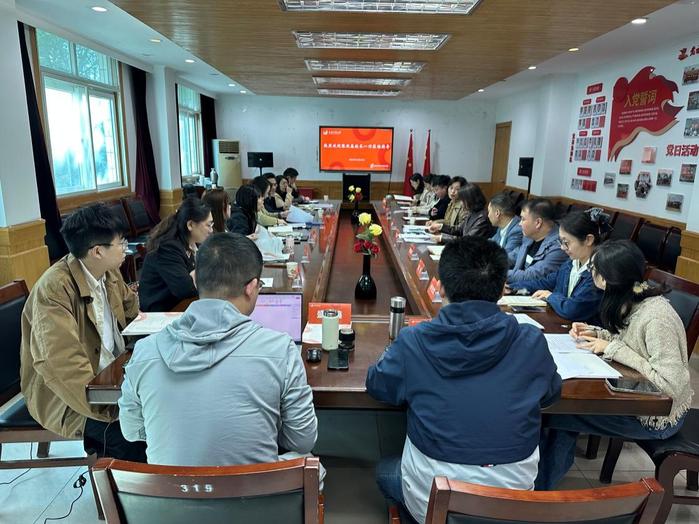
At the subsequent symposium, Zhou Xiaojun welcomed President Zhang on behalf of the Business School faculty and students. She emphasized the importance of the visit in strengthening communication between the school and university administration while guiding the college's strategic development. Zhou highlighted recent achievements and outlined future plans, after which and Deputy Dean of Business School Ding Xiaohua detailed the school's initiatives in Party building and educational innovation. Faculty members actively contributed practical suggestions during the discussion session.
President Zhang acknowledged the Business School's accomplishments during the 14th Five-Year Plan period and provided strategic guidance for the upcoming 15th Five-Year Plan: first, pursuing excellence in business education by transcending conventional academic models through proactive external engagement, particularly via deepened partnerships with industry leaders and premier academic institutions to advance integrated industry-education collaboration and research-teaching synergy; second, systematically enhancing operational efficiency by optimizing governance structures and resource allocation across teaching, research, and practical training while accelerating the implementation of core initiatives including specialty program modernization, faculty capacity building, and innovative talent development frameworks; third, drawing inspiration from benchmark institutions like Shanghai Open University's successful integration of diverse educational modalities, the Business School should pioneer creative approaches to multi-dimensional education convergence, ultimately cultivating distinctive business education excellence that produces highly skilled professionals capable of driving regional industrial transformation and sustainable economic development. President Zhang stressed that the Business School must demonstrate proactive leadership, elevating all initiatives to new heights in this developmental phase to make more substantial contributions toward establishing the university as a premier higher education institution.
The Business School pledged to implement these recommendations, incorporating the guidance into concrete action plans to enhance educational quality and competitive advantage while supporting the university's overall development strategy. The visit concluded with commitments to translate insights into measurable improvements across teaching, research, and industry collaboration initiatives.